

Cowhide leather explained: qualities, uses, and how to choose

TL;DR:
- Cowhide leather is the most durable and thickest leather, ideal for long-lasting jackets and motorcycle gear.
- Full-grain cowhide offers superior strength, develops a unique patina, and maintains shape over time.
- Quality can be identified through physical tests like scratch recovery and the pull-up effect, regardless of brand.
Most people buying their first leather jacket assume all leather is basically the same. They’re wrong, and that mistake costs them. Cowhide leather is one of the most widely used materials in apparel, yet its real advantages are almost never explained clearly. Whether you’re buying a motorcycle jacket for actual road protection or a fashion piece you want to last decades, understanding cowhide’s durability and unique qualities changes how you shop, what you look for, and how long your gear holds up.
Table of Contents
- What is cowhide leather?
- Cowhide vs. other leather types: Key differences
- How to judge cowhide leather quality
- Why cowhide leather jackets and gear stand out
- Care tips to make cowhide leather last
- Why quality testing and informed buying matter more than brand
- Find your perfect cowhide leather jacket
- Frequently asked questions
Key Takeaways
| Point | Details |
|---|---|
| Cowhide is durable | Cowhide leather stands out for its thick, tough nature, ideal for jackets and protective gear. |
| Full-grain is best | Full-grain cowhide delivers unmatched longevity and a rich, authentic look over time. |
| Quality is testable | Simple techniques like the pull-up effect and nail scratch test reveal real leather quality. |
| Care boosts lifespan | Proper cleaning, conditioning, and storage keep cowhide apparel looking and performing great. |
| Customization shines | Cowhide’s versatility allows for a wide range of personalized jacket and gear options. |
What is cowhide leather?
Cowhide leather comes from the hide of domesticated cattle. It’s the most common type of leather on the market, and for good reason. After the hide is removed, it goes through a process called tanning. Tanning preserves the skin and transforms it from raw material into a stable, wearable product. There are two main tanning methods: vegetable tanning, which uses natural plant-based compounds and produces firmer leather with deep character, and chrome tanning, which is faster and more consistent but sometimes produces a slightly softer result.
The origins of cowhide leather trace back thousands of years across cultures. What hasn’t changed is its core value: it’s thick, durable, and plentiful. Once tanned, the hide is graded and then finished. This is where quality starts to diverge significantly.
The three main grades of cowhide leather
Understanding what is full-grain leather versus other grades is the single most important thing you can learn before buying:
- Full-grain leather retains the entire natural grain surface of the hide, including all its subtle variations and markings. It’s the strongest, most durable option and develops a rich patina (a natural sheen that builds over time from use).
- Top-grain leather is sanded or buffed to remove surface imperfections. It’s more uniform in appearance, slightly softer, and easier to work with, but marginally less durable than full-grain over a very long timeline.
- Corrected-grain leather gets a heavy artificial texture applied to its surface to hide flaws. It looks consistent but performs the worst of the three, especially in high-use situations.
| Grade | Surface | Durability | Feel | Best use |
|---|---|---|---|---|
| Full-grain | Natural | Highest | Firm, develops patina | Moto gear, long-term jackets |
| Top-grain | Sanded/buffed | High | Smooth, consistent | Fashion jackets |
| Corrected-grain | Artificial texture | Moderate | Uniform | Budget apparel |
Full-grain is hands-down the best option for anyone who wants a jacket that gets better with age. Cowhide is tougher and thicker than lambskin or goatskin, which is why it remains the standard for motorcycle protection and heavy-use fashion pieces.

Cowhide vs. other leather types: Key differences
Once you understand what cowhide is, comparing it to other popular leathers will help clarify its unique strengths and where it sits in the bigger picture.
The leather world has several heavy hitters. Lambskin, goatskin, horsehide, and cowhide each occupy different positions based on feel, protection, cost, and availability. Knowing these differences helps you spend smarter.
Breaking down the comparison
The comparison between lambskin vs. cowhide comes up constantly. Lambskin is buttery soft and lightweight, which makes it beautiful for fashion pieces. But it’s noticeably thinner and less resistant to abrasion. One serious fall on a motorcycle wearing lambskin is a very different outcome than the same fall in cowhide.
Goatskin is tougher than lambskin but still falls behind cowhide in thickness and protection. It does have a distinctive pebbled texture that some people prefer aesthetically.
Horsehide is the performance king. It actually has a tensile strength (the force required to pull it apart) of roughly 5,000 to 6,000 PSI, compared to cowhide’s lower rating. Cowhide has 35 to 45% less tensile strength than horsehide. That sounds like a big gap, but horsehide is rare, expensive, and far less available globally. Cowhide fills that performance gap with excellent abrasion resistance and far greater supply, making it the practical choice for most riders and fashion buyers.
There are also some persistent truths and myths about lambskin worth understanding. Many buyers think lambskin is “premium” because it feels luxurious, but for motorcycle use specifically, that softness is actually a liability.
| Leather type | Thickness | Abrasion resistance | Cost | Availability |
|---|---|---|---|---|
| Cowhide | High | High | Moderate | Widely available |
| Lambskin | Low | Low | Moderate to high | Common |
| Goatskin | Medium | Medium | Moderate | Common |
| Horsehide | High | Very high | High | Limited |
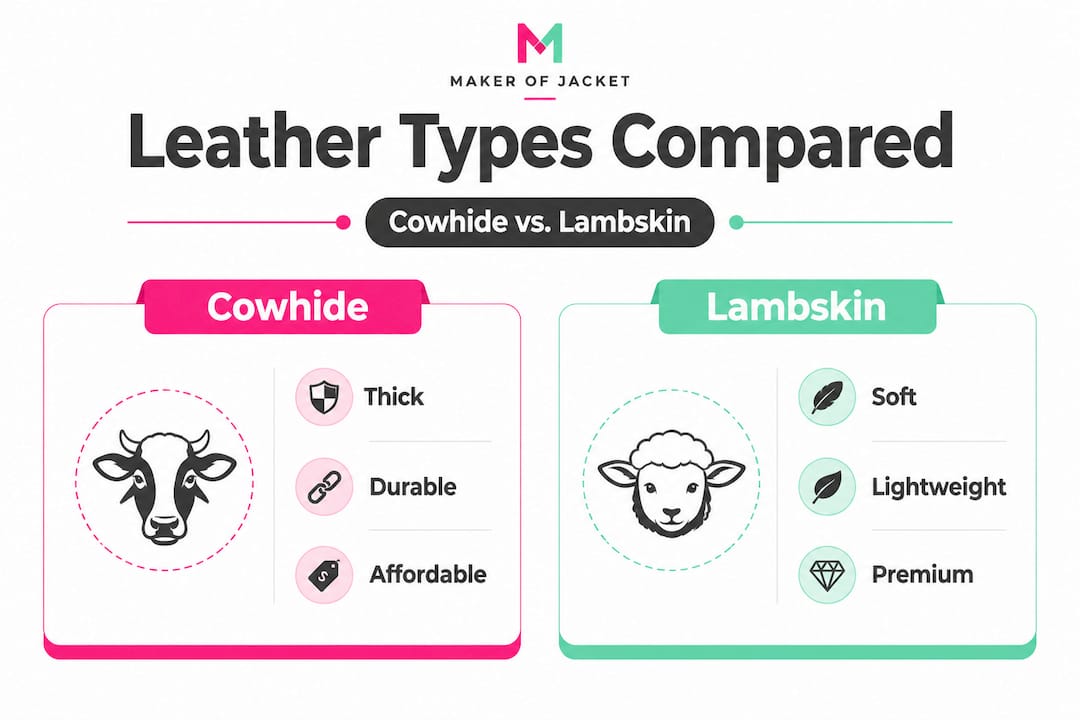
The bottom line: cowhide delivers the best balance of performance, availability, and price for the vast majority of buyers.
How to judge cowhide leather quality
Understanding cowhide’s place among leathers leads to the crucial topic: how to tell if what you’re buying is truly high quality. This is where most shoppers get lost, because marketing terms can be confusing and sellers don’t always volunteer the important details.
Step-by-step quality checks
- Check the grade first. Ask or confirm whether the leather is full-grain, top-grain, or corrected-grain. If the seller can’t tell you, that’s a red flag.
- Look at the surface closely. Genuine full-grain cowhide shows natural variations in texture. Perfectly uniform grain patterns usually indicate corrected-grain or even synthetic leather.
- Try the scratch test. Run your fingernail gently across the surface. On high-quality full-grain cowhide, scratch recovery happens quickly as the natural oils in the hide close the mark. On lower grades or fakes, the scratch stays.
- Look for the pull-up effect. When you bend or press quality full-grain cowhide, it temporarily lightens in color where stretched, then returns to its original shade. This is called the pull-up effect and it’s a reliable indicator of authentic, well-tanned leather with natural oils intact.
- Smell it. Genuine cowhide has a distinctive earthy, rich smell. Synthetic materials often smell faintly chemical or plasticky.
- Check weight and thickness. Quality cowhide jackets are noticeably heavier than synthetic alternatives or thin lambskin pieces.
“Hide quality varies significantly by cattle age, breed, and regional origin. Hides from cattle aged 18 to 24 months, particularly from Angus and Hereford breeds raised in the US Midwest and Europe, are consistently among the most respected for leather goods production.”
This context matters when you’re trying to spot fake leather or verify that a jacket is worth its price. You won’t always know the breed or region, but full-grain status and the physical tests above give you strong signals.
Pro Tip: When shopping online, always ask the seller for close-up photos of the inner lining and the raw edge of the leather at seams. Genuine cowhide will show fiber structure at cut edges, not smooth or plastic-looking surfaces.
Understanding identifying genuine leather goes beyond the label. Trust the physical evidence over the tag every single time.
Why cowhide leather jackets and gear stand out
Knowing how to identify quality lets you make smart decisions. But why do cowhide jackets and gear claim the spotlight for buyers and riders alike? The answer goes beyond just toughness.
What makes cowhide the standard
For motorcycle riders, the choice often comes down to protection. A jacket is the primary barrier between skin and asphalt in a slide. Cowhide is tougher and thicker than lambskin or goatskin, which directly translates to more abrasion resistance in a crash scenario. That’s not a small detail. That’s the difference between road rash and real injury.
In fashion, cowhide brings something different to the table. It holds structure. A cowhide biker jacket keeps its silhouette through years of regular wear, something that softer leathers can’t always maintain. It also customizes beautifully. Cowhide takes dyes, embossing, hardware, and stitching details exceptionally well, which is why it’s the backbone of so many types of fashion jackets from bomber styles to trench coats.
Key benefits at a glance
- Longevity: Quality full-grain cowhide jackets can last 20 to 30 years with proper care
- Wear resistance: Holds up against daily friction, whether from a motorcycle seat or regular urban use
- Patina development: Develops a unique, personal character over time that makes each jacket one of a kind
- Customizability: Accepts color, texture, and detail modifications better than most leathers
- Structure: Maintains shape and form through heavy use
- Protection: Unmatched abrasion resistance for motorcycle gear compared to softer alternatives
Pro Tip: Choose full-grain cowhide if your jacket will see heavy or outdoor use, motorcycle riding, or intense weather. Go with top-grain if you want a cleaner, more polished finish for everyday fashion wear while still getting solid durability.
Care tips to make cowhide leather last
To protect your investment, here are simple care steps to keep cowhide leather looking new and performing at its best for years.
Cowhide is tough, but neglect breaks down even the best leather. The natural oils in the hide are what keep it supple and crack-resistant. Those oils deplete over time through exposure to heat, water, and air, so your job is to replace them.
Simple care routine
- Wipe down regularly. Use a soft, dry cloth to remove dust and surface dirt after each use. For deeper cleaning, use a leather-specific cleaner applied lightly with a damp cloth.
- Condition every three to six months. Apply a leather conditioner or balm designed for cowhide. This replenishes the oils that prevent cracking. Work it in with circular motions and let it absorb fully.
- Keep it away from direct heat. Radiators, direct sunlight, and hot car interiors dry out leather fast. Store your jacket away from heat sources.
- Dry it naturally if it gets wet. Never use a hairdryer or heater to speed up drying. Hang it at room temperature and let it dry slowly to avoid stiffening or cracking.
- Store it on a wide, padded hanger. Thin wire hangers distort the shoulders over time. A wide hanger keeps the jacket’s shape intact.
Full-grain cowhide lasts longest when you pair it with consistent, simple care. Neglected full-grain will still outlast well-maintained corrected-grain, but proper upkeep is the real multiplier for longevity.
These leather care tips apply across jacket styles and uses, from everyday fashion to motorcycle gear.
Pro Tip: Store your jacket in a breathable cotton garment bag, never in a plastic bag or sealed container. Plastic traps moisture and promotes mildew growth inside the leather, which can permanently damage the hide.
Why quality testing and informed buying matter more than brand
Here’s an opinion that might surprise you: a recognizable brand name tells you almost nothing meaningful about the actual leather in a jacket. We’ve seen beautifully labeled, expensive jackets made from corrected-grain leather dressed up with heavy marketing, and we’ve seen unbranded jackets built from exceptional full-grain cowhide that will outlast them by decades.
The uncomfortable reality is that leather quality is determined in the tannery and in the hide selection, not in the marketing department. Buyers who rely on brand reputation alone hand over the most important part of the decision to someone else. That’s a choice that often results in disappointment, especially when the jacket starts peeling or cracking within a few years.
The tools you actually need are physical tests. The pull-up effect and scratch recovery tell you more about a hide’s quality in ten seconds than a brand name can tell you in ten years. These aren’t complicated techniques. They’re just paying attention.
This matters even more when you’re buying online. You can’t touch the leather directly, so you have to ask the right questions: What grade is the leather? Where do the hides come from? Is it full-grain or top-grain? Reputable sellers answer these questions clearly. The ones who dodge or use vague language like “premium quality leather” without specifics are telling you something important.
Learning to master leather testing techniques puts the power back in your hands. No logo guarantees quality. Your own knowledge does.
Find your perfect cowhide leather jacket
You’ve learned what separates excellent cowhide leather from average, how to test it, and what to look for in a jacket built to last. Now it’s time to put that knowledge to work.
At Maker of Jacket, you can customize your cowhide jacket from the ground up, choosing the leather grade, color, finish, stitching detail, and fit. Every jacket is built to your specifications using high-quality materials and real craftsmanship. You’re not buying off a shelf and hoping for the best. You’re making a deliberate choice backed by everything you now know about what good cowhide leather actually is. Explore handmade leather jackets across styles from biker and bomber to fashion-forward custom pieces, with worldwide free shipping and a clear size guide to make the process straightforward.
Frequently asked questions
Is cowhide leather real leather?
Yes, cowhide leather is genuine leather made from the skin of cattle, and it’s valued for its durability and thickness compared to other common hides.
What is the best type of cowhide leather for jackets?
Full-grain cowhide is the best choice for jackets because it retains the natural grain for maximum strength and develops a unique patina that improves its look over time.
Why is cowhide popular for motorcycle gear?
Cowhide offers high abrasion resistance and greater thickness than softer leathers, making it the most practical and protective choice for riders in the event of a fall or slide.
How do I spot authentic cowhide leather?
Test for the pull-up effect when bending the leather and check whether a light fingernail scratch recovers quickly. Both indicate genuine, well-tanned full-grain cowhide.
Can cowhide leather be customized?
Yes, cowhide takes dyes, embossing, hardware, and stitching modifications exceptionally well, making it the most versatile leather for bespoke jackets, suits, and motorcycle gear.
Recommended
- Ultimate Guide on Cowhide Leather: Origins, Characteristics, Benefits, Care, and Applications – Maker of Jacket
- Cowhide vs Buffalo Leather: Which Performs Better for Motorcycle Gear? – Maker of Jacket
- Best Leather for Jackets – Find the Right Material for You – Maker of Jacket
- Nubuck vs Suede Leather – Key Differences You Should Know – Maker of Jacket
- Leather Handle Cover – Brass & Steel


