

Leather Grading Explained: Make Smarter Apparel Purchases

TL;DR:
- Leather grading mainly indicates surface appearance, not durability or quality.
- Keys to quality include tensile strength, shrinkage temperature, and abrasion resistance.
- Always verify leather type, yield, and testing data when purchasing custom jackets.
Most buyers assume a “Grade A” label or “Top Grain” stamp is a reliable shortcut to quality leather. It is not. These designations were created to help tanners sort hides by surface appearance, not to predict how a jacket will hold up after two winters. The leather industry lacks a universal grading authority, which means one brand’s “Grade A” can look nothing like another’s. If you are shopping for custom leather apparel and want it to last, you need a different framework. This article breaks down what leather grades actually measure, what the real performance indicators are, and exactly how to use that knowledge when buying a custom jacket.
Table of Contents
- Understanding leather grades and industry terms
- The science behind grading: What really matters
- Leather grade vs. type: How they interact and what you should buy
- Evaluating leather in the real world: Smart shopping steps
- Our perspective: What leather grading really means for custom apparel buyers
- Explore premium custom jackets with confidence
- Frequently asked questions
Key Takeaways
| Point | Details |
|---|---|
| Grading isn’t everything | Grades like A or B are only a starting point and often miss key performance factors. |
| Performance trumps labels | Tensile strength and lab tests predict durability better than impressively named grades. |
| Type and grade work together | The best leather for custom apparel combines the right type with proven quality standards. |
| Ask for proof | Buyers should request defect photos and test results—not just trust grade labels. |
| Shop smarter | Use these insights to get reliable, lasting custom leather products, not just buzzwords. |
Understanding leather grades and industry terms
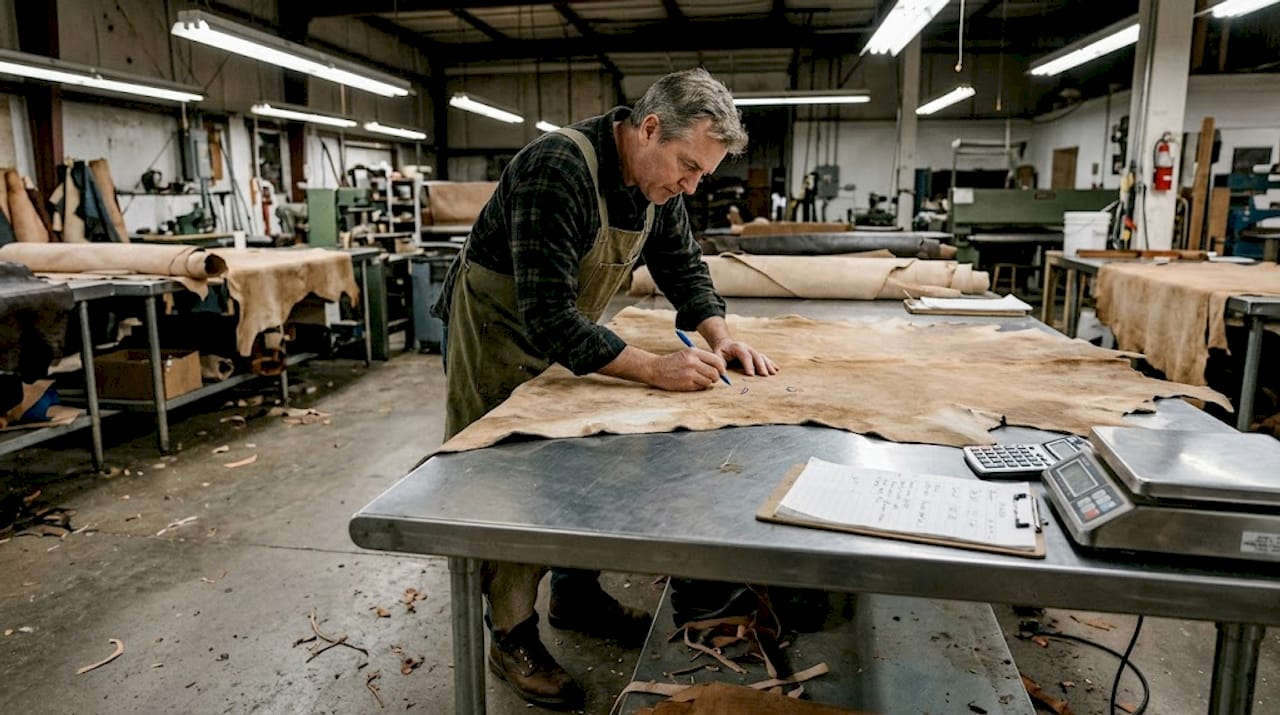
Leather grading started as a tannery sorting system, not a consumer quality guarantee. When hides arrive at a tannery, workers inspect them for scars, insect bites, branding marks, and uneven thickness. They assign letter grades based on how much of the hide is usable and how clean the surface looks. Grade A hides have fewer visible defects. Grade B and C hides have more. That is essentially the whole system.
Here is where buyers get tripped up: grade does not equal durability. A Grade A hide from a poorly managed tannery can be structurally weaker than a Grade B hide that went through a rigorous finishing process. The label tells you about surface appearance at the time of sorting, nothing more.
The terminology gets even murkier once you add leather types to the mix. Here are the most common terms you will encounter:
- Full grain leather: The outermost layer of the hide, with the natural grain intact. Nothing is buffed or sanded away. It is the most durable and develops a patina over time. Explore the details of full grain leather before assuming a jacket carries it.
- Top grain leather: The surface layer, but lightly sanded to remove imperfections. More uniform looking, slightly less durable than full grain. Understanding full grain vs top grain matters before you spend serious money.
- Corrected grain leather: Heavily buffed and embossed with an artificial grain pattern. Looks consistent but has compromised the fiber structure.
- Split leather: Cut from the lower layers of the hide, after the top grain has been removed. Significantly weaker and cheaper.
- Bonded leather: Scraps and fibers glued together with polyurethane. Not real leather by most craft standards.
The industry’s own glove standards in leather recommend requesting yield expectations and defect photos, and testing via standards like tensile strength rather than relying on letter grades alone, precisely because of how variable those grades are in practice.
Yields, by the way, refer to the percentage of a hide that is actually usable after defects are cut away. A high-yield hide means fewer wasted areas and more consistent material in your finished jacket. Sellers who cannot answer yield questions are a red flag. If you want to sharpen your understanding of how all these terms fit together, the leather terminology guide covers a broad range of language you will run into while shopping.
The science behind grading: What really matters
Once you move past surface labels, the real indicators of leather quality are measurable and objective. Three metrics matter most for apparel buyers.
Tensile strength measures how much force the leather can withstand before tearing. It is tested using ASTM D2209, a standardized method where strips of leather are pulled apart until failure. High-quality garment leather typically performs well above minimum thresholds. Weak leather tears more easily at seams and stress points, exactly where a jacket fails first.
Shrinkage temperature (Ts) measures hydrothermal stability, which is how well the leather holds up when exposed to heat and moisture. Leather with a low Ts can shrink, warp, or crack after rain or sweat exposure. Well-tanned leather for outerwear should have a Ts above 80°C.
Abrasion resistance measures how many cycles of friction the surface can endure before degrading. Premium synthetic analogs used in comparison testing often benchmark at 50,000 to 100,000+ cycles. Quality garment leather should be in a competitive range.
| Metric | What it measures | Why it matters for jackets |
|---|---|---|
| Tensile strength (ASTM D2209) | Force before tearing | Seam and stress point durability |
| Shrinkage temperature (Ts) | Heat and moisture stability | Protection from rain and sweat damage |
| Abrasion resistance | Surface wear over cycles | Long-term appearance and structure |
| Defect rate / yield | Usable hide percentage | Consistency of final product |
Stat callout: Leather shrinkage temperature below 70°C is a major warning sign for outerwear, as hydrothermal stability directly predicts how leather behaves in real weather conditions.
Pro Tip: When contacting a seller about a custom jacket, ask specifically for the leather’s tensile strength data and shrinkage temperature rating. A supplier who works with quality material will have this information available. One who cannot answer is likely working with commodity-grade hides.
Knowing these numbers also helps when you use a step-by-step quality guide to evaluate a jacket before purchase. Science-backed metrics beat marketing language every single time.
Leather grade vs. type: How they interact and what you should buy
Here is where things get practically useful. Grades and types are two separate axes, and smart buyers evaluate both before committing to a purchase.

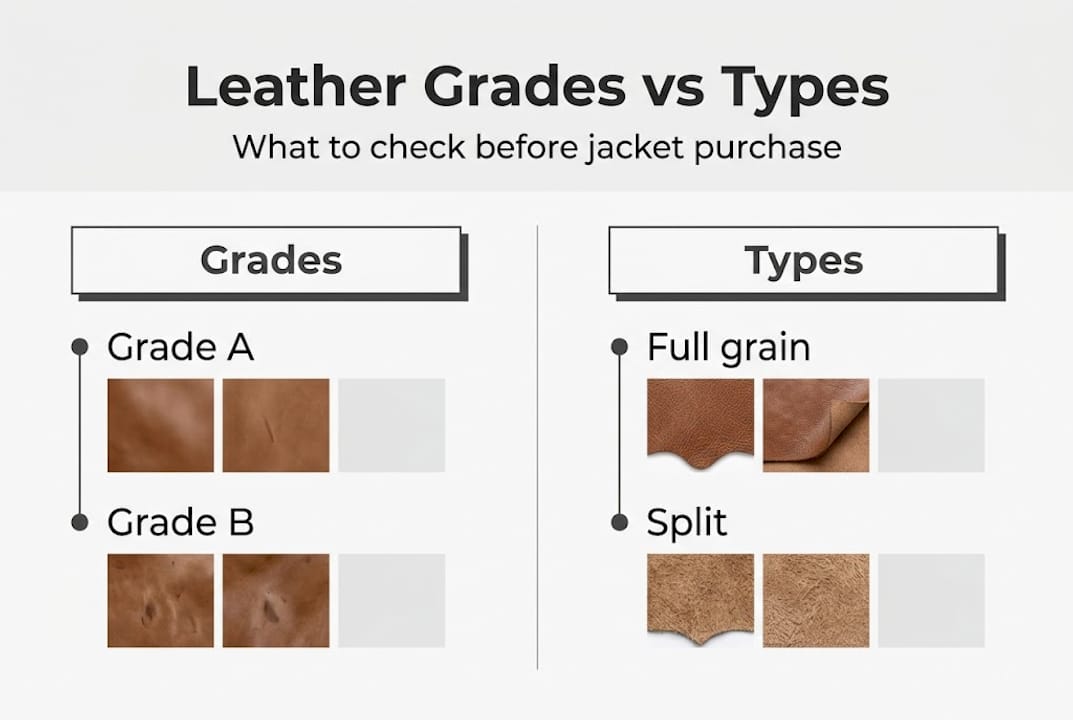
Think of it this way: type tells you which part of the hide you are getting, and grade tells you the condition of that part. A Grade A split leather is still split leather, which means it is structurally inferior to a Grade B full grain hide. The grade did not save it.
Here is a comparison of common combinations and what they really signal:
| Leather type | Grade A | Grade B | What to expect |
|---|---|---|---|
| Full grain | Best choice | Strong option | Max durability, natural patina |
| Top grain | Good quality | Acceptable | Uniform look, slightly less tough |
| Corrected grain | Cosmetically clean | Not recommended | Weakened fiber structure |
| Split | Still weak | Avoid | Poor longevity regardless of grade |
| Bonded | Avoid | Avoid | Not real leather, no durability |
For custom apparel, the winning combination is Grade A or B full grain leather. Top grain leather is a reasonable second choice when full grain is unavailable, especially if the tanning quality is high.
Common traps buyers fall into:
- Paying a premium for “Grade A” corrected grain, which is just well-sorted inferior material
- Assuming “genuine leather” means good leather, when it legally covers everything from split to bonded
- Ignoring the tanning method, since vegetable-tanned leather and chrome-tanned leather behave very differently in wear
Pro Tip: The phrase “genuine leather” is the minimum legal requirement to call something leather in many markets. It says almost nothing about quality. Focus on type and testing data instead.
The best leathers for jackets guide offers a side-by-side breakdown that pairs well with what you are learning here. If you are deciding between real leather and alternatives, the leather vs faux leather guide covers the trade-offs honestly.
Understanding the glove standards principle of requesting yield data applies directly here. Always ask your supplier what grade and type combination you are actually receiving, and get it confirmed in writing.
Evaluating leather in the real world: Smart shopping steps
Knowing the theory is one thing. Using it while shopping for a custom jacket is another. Here is a practical sequence to follow before you commit your money.
- Ask for the leather type in writing. Get confirmation that it is full grain or top grain, not just “genuine leather” or “premium leather.”
- Request defect photos or hide samples. Reputable suppliers will show you what the raw material looks like before cutting. This protects you from hidden flaws.
- Ask for yield expectations. A supplier using quality hides will quote yield rates. Low yields mean more patching and inconsistency in your finished jacket.
- Request tensile strength and shrinkage temperature data. You do not need a lab report, but a credible supplier can reference the tannery’s data sheet. Per industry testing standards, these metrics are more reliable than any grade label.
- Physically test if possible. Quality leather resists surface scratching when you drag a fingernail lightly. It also returns to shape after a gentle fold, rather than creasing permanently.
- Check for consistent texture and thickness. Hold the leather up to light and feel across the surface. Inconsistent thickness signals low yield or split leather blending.
- Look for transparency about the tanning process. Vegetable tanning and chrome tanning affect durability, aging, and maintenance differently. Sellers who can explain this are working with material they know.
When shopping online, learn to spot fake leather by studying surface texture photos closely. Artificially embossed grain has a uniformity that natural grain does not. If you are ordering online, the guide to ordering custom leather jackets walks through how to structure your communication with makers. And if you are weighing accessories alongside outerwear, buying leather vests follows a similar evaluation process.
Custom does not automatically mean quality. It means the jacket is made to your spec, using whatever material the maker has sourced. Your job is to verify the source.
Our perspective: What leather grading really means for custom apparel buyers
After seeing countless jackets come through, here is our honest read: the letter grade system serves sellers far more than buyers. It gives a marketing-friendly shorthand that sounds authoritative but communicates very little about how a jacket will actually hold up over time.
The jackets that fail, and they do fail, almost always fail at predictable stress points: collar seams, zipper reinforcement areas, and elbow panels. Not one of those failures was caused by a Grade B hide. They were caused by poor tanning, incorrect thickness selection, and inadequate construction. The grade label was irrelevant.
The buyers who end up with the best jackets do one thing differently: they ignore the marketing language and ask specific, uncomfortable questions. They want yield data. They want to know the tanning method. They reference differences in leather types when comparing quotes. They treat the purchase like an investment, because a well-made full grain jacket built to proper standards genuinely is one.
Grading is a starting point, not a conclusion. Treat it that way.
Explore premium custom jackets with confidence
Now that you know how to read between the lines on leather grades and types, you are ready to shop with real criteria in your corner.
At Maker of Jacket, every custom order starts with a conversation about your needs, not a generic grade stamp. You can explore the full range of custom jacket options and see exactly how bespoke orders are handled. Our customization journey page explains what happens from your first request to your finished jacket. And once your piece arrives, the leather care tips guide will help you protect that investment for years to come. Quality leather, chosen wisely and cared for properly, is genuinely a lifetime product.
Frequently asked questions
What is the difference between leather grade and leather type?
Leather grade ranks the visual and structural quality of a hide at sorting, while leather type describes how the hide was processed and which layer was used. Both factors impact durability, and grading and type are related but distinct concepts that together define what you are actually buying.
Does a higher leather grade always mean better quality?
No. Higher grades typically reflect surface appearance at the tannery, not long-term durability. Testing via standards like tensile strength gives you far more reliable information than a letter grade alone.
Which tests best predict leather durability?
Tensile strength, shrinkage temperature, and abrasion resistance are the three most useful metrics for outerwear. Shrinkage temperature and tensile strength together indicate how the leather will respond to real wear, weather, and stress over time.
How can I check if a custom jacket uses quality leather?
Request detailed photos of the raw hide, ask for defect rates and yield expectations, and specifically ask for tensile strength or tannery data sheets. Suppliers confident in their material will provide this without hesitation, as yield expectations and defect photos are standard practice for quality-focused makers.
Recommended
- Why Invest in Quality Leather – Long-Term Value Unpacked – Maker of Jacket
- How to Spot Fake Leather: Master Identification Techniques – Maker of Jacket
- Leather Jacket Terminology: Making Informed Choices – Maker of Jacket
- Cowhide vs Buffalo Leather: Which Performs Better for Motorcycle Gear? – Maker of Jacket


