

Top jacket styles and customization for personal style


TL;DR:
- Over a dozen distinct jacket styles serve various functions and personal styles.
- Material choice impacts protection, comfort, and seasonal suitability for each jacket type.
- Customization through patches and embroidery personalizes jackets, enhancing style and identity.
Most people own two or three jackets and think they’ve covered all their bases. They haven’t. There are more than a dozen distinct jacket styles, each with its own history, function, and personality, and most guides barely scratch the surface. Whether you ride motorcycles, dress for business casual, or just want to stand out on the street, knowing the difference between a field jacket and a blazer, or a bomber and a biker, changes everything. And when you layer in customization, patches, embroidery, and hybrid designs, you stop wearing clothes and start making a statement that’s entirely your own.
Table of Contents
- Classic jacket styles: Origins and defining features
- Blazers, sport coats, and suit jackets: Decoding formal layers
- Material matters: Abrasion, breathability, and seasonal versatility
- Personalization and customization: Patches, embroidery, and hybrid designs
- What most guides miss: Balancing style, protection, and individuality
- Explore your custom jacket journey: Make it your own
- Frequently asked questions
Key Takeaways
| Point | Details |
|---|---|
| Classic styles explained | Understanding iconic jacket types gives you clarity on function and fashion. |
| Material impacts performance | Choosing leather, denim, or nylon affects your comfort, protection, and versatility. |
| Customization unlocks uniqueness | Personal touches like patches and embroidery let you express your identity and story. |
| Balance style and safety | It’s possible to combine protection and style for everyday and riding use. |
| Practical selection tips | Smart layering, seasonal adaptations, and designer details help you maximize your wardrobe. |
Classic jacket styles: Origins and defining features
Now that we’ve set the stage, let’s break down these classic jacket styles and see how each one fits unique needs.
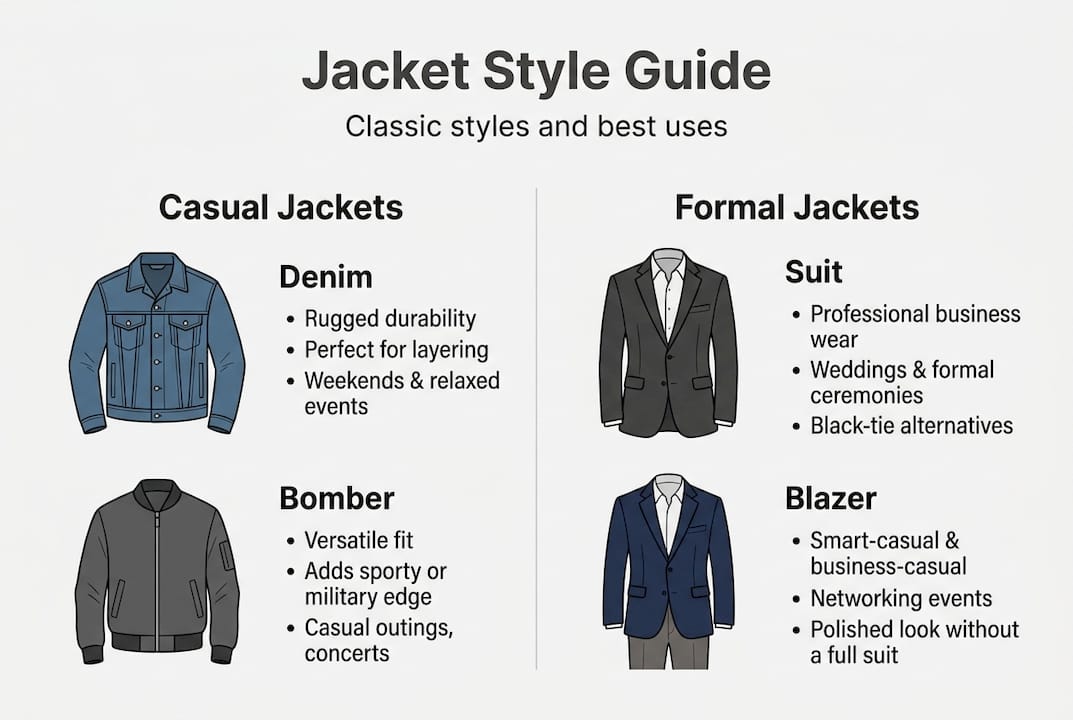
The denim jacket is a year-round staple with roots in 1880s workwear, built from durable cotton denim that holds up to daily abuse. Its defining features are the chest pockets, button front, and that slightly structured silhouette that layers perfectly over hoodies or under heavier coats. It’s one of the most versatile pieces in any wardrobe because it bridges casual and smart casual effortlessly.
Leather Jackets
Leather jackets are in a category of their own. The biker and moto styles feature an asymmetrical zip and belted waist, which gives them that aggressive, road-ready look. Blazer-style leather jackets clean up the silhouette for a more polished look, while leather bombers split the difference. For motorcycle riders especially, leather isn’t just style. It’s protection.
Bomber Jackets
The bomber jacket originated with WWII pilots who needed warmth at altitude without bulk. Today’s versions in nylon or leather keep that relaxed, ribbed-cuff design but work just as well on city streets as in the cockpit. The fit is intentionally easy, making it one of the most comfortable casual jackets you can own.
Trench Coats
The trench coat was invented in the mid-19th century to keep soldiers and civilians dry. It’s light, water-repellent, and double-breasted, with a mid-calf length that gives it serious presence. It reads as formal but pairs just as naturally with jeans.
Finally, the field jacket comes from M-65 military design, built with four flap pockets for utility and a generous fit that allows layering. The barn jacket is a civilian cousin, softer and less structured, but sharing that same practical DNA.
Here’s a quick comparison to keep it straight:
| Style | Key features | Best use |
|---|---|---|
| Denim | Button front, chest pockets | Casual layering, everyday |
| Leather biker | Asymmetrical zip, belt | Riding, edgy street style |
| Bomber | Ribbed cuffs, relaxed fit | Casual, weekend wear |
| Trench coat | Double-breasted, mid-calf | Rain, smart casual |
| Field jacket | 4 flap pockets, military cut | Outdoor, utility |
Pro Tip: When exploring must-have jacket styles, focus on owning at least one casual and one weather-resistant option before adding specialty pieces.
Blazers, sport coats, and suit jackets: Decoding formal layers
Having explored casual and utility jackets, let’s shift to the essential formal layers that round out your wardrobe.
These three pieces confuse even experienced dressers. They look similar at a glance, but they serve very different social functions. Getting them mixed up can make you look underdressed or overdressed in ways that are hard to recover from.
According to GQ’s breakdown, the suit jacket is part of a matched set. It’s structured, comes in muted solids or subtle patterns, and only works correctly when paired with its matching trousers. Wearing a suit jacket with mismatched pants reads as a mistake, not a style choice.

The sport coat is the most relaxed of the three. It’s colorful, patterned, and designed to stand alone. Tweed, plaid, and herringbone are classic sport coat fabrics. It’s the right call for dinners, creative workplaces, and events where you want to look put-together without going full formal.
The blazer sits between them. Navy is the classic color, often with gold or brass buttons, and it works as a standalone piece. It’s semi-formal enough for business casual and relaxed enough for smart casual events. The blazer is arguably the most versatile formal layer you can own.
| Piece | Paired with | Formality level | Best occasion |
|---|---|---|---|
| Suit jacket | Matching trousers | High | Formal events, business |
| Sport coat | Chinos, jeans | Low to medium | Casual dinners, creative work |
| Blazer | Almost anything | Medium | Business casual, social events |
Here’s what trips people up most often:
- Wearing a suit jacket as a standalone piece looks incomplete
- Pairing a sport coat with formal trousers creates a mismatch in tone
- Blazers with overly casual bottoms like athletic shorts undercut the whole look
Pro Tip: If you’re building a wardrobe from scratch, buy a navy blazer before anything else. It works harder than any other formal layer you’ll own.
Material matters: Abrasion, breathability, and seasonal versatility
After understanding jacket types, it’s crucial to examine how materials drive both comfort and performance.
Material choice is where most people leave real value on the table. You can pick the perfect style and still end up with a jacket that’s uncomfortable in summer, useless in rain, or dangerously under-protective on a motorcycle.
Leather is the gold standard for abrasion resistance. Leather outperforms textile and mesh in crash scenarios, which is why serious riders default to it. The tradeoff is weight and heat. Leather doesn’t breathe well, so wearing it in summer requires ventilation panels or a willingness to sweat. Many experienced riders own multiple jackets for different seasons, which is genuinely smart practice, not excess.
Here’s how the main materials stack up:
- Leather: Best abrasion resistance, long lifespan, heavy, warm, ideal for riding and cold weather
- Denim: Breathable, flexible, great for casual wear, limited protection in falls
- Nylon: Lightweight, water-resistant, excellent for rain and wind, packs down small
- Cotton blends: Comfortable for casual layering, poor protection for riding, great for mild weather
- Mesh: Maximum airflow, minimal protection, best for summer riding with armor inserts
For seasonal jacket choices, the smart move is matching material to conditions rather than defaulting to one jacket year-round. A nylon bomber in spring, leather biker in fall, and a cotton field jacket in summer gives you coverage without compromise.
Pro Tip: If you’re deciding between biker versus bomber jackets for riding, always prioritize CE-rated armor compatibility over aesthetics. A jacket that looks great but offers no protection is just an expensive shirt.
Personalization and customization: Patches, embroidery, and hybrid designs
Once you’ve chosen a style and material, it’s time to make it yours with customized details.
Customization is where a jacket stops being a product and starts being an identity. The difference between a jacket you wear and one you love is almost always in the details that make it specific to you.
Patches
Patches on denim and leather are one of the most powerful storytelling tools in fashion. Embroidered and woven patches hold up best on these fabrics, and you can choose between sew-on options for permanence or iron-on for flexibility. Placement matters enormously. A single centered back patch makes a bold statement. Clustered chest and sleeve patches create a layered, collected look.
Embroidery
Embroidery takes personalization further. Unlike patches, embroidery is directly integrated into the fabric, which means it won’t peel, fade, or fall off. Custom logos, names, and graphic designs stitched into leather or denim create a finish that looks intentional and premium. You can explore embroidery for custom jackets to see how design complexity affects cost and durability.
Hybrid jackets
Hybrid jackets, those combining leather panels with denim or nylon sections, offer the most advanced form of personalization. You get the protection of leather where it counts and the breathability of other materials elsewhere.
“A custom jacket isn’t just clothing. It’s a record of who you are, where you’ve been, and what you stand for, without saying a word.”
Here are the key customization options and where they work best:
- Embroidered patches: Denim, leather, bomber styles
- Iron-on patches: Denim jackets, casual nylon
- Direct embroidery: Leather biker jackets, varsity jackets
- Color blocking: Hybrid leather and denim designs
- Custom lining: Any jacket style, adds surprise detail
For practical guidance, adding patches to jackets covers placement and technique, while customizing leather jackets walks through advanced options. If you ride, personalizing motorcycle jackets shows how to add custom details without compromising safety features.
Pro Tip: Avoid customizing silk, satin, or very thin synthetic jackets with heavy embroidery. The fabric can pucker or tear under the tension of dense stitching.
What most guides miss: Balancing style, protection, and individuality
With the fundamentals covered, here’s how you can rethink your approach and maximize the impact of your jacket choices.
Most jacket guides stop at style. They tell you what looks good and leave the rest to chance. What they miss is the triangle of style, protection, and individuality, and how these three things reinforce each other when you get it right.
We’ve seen riders choose a jacket purely for its look and skip the armor pockets. We’ve seen fashion-conscious buyers pick a material that falls apart in six months because they didn’t know what to ask for. The hard-won lesson is this: never compromise the core mechanics of a jacket when customizing it. Don’t remove structural panels to add patches. Don’t skip CE-rated armor because it changes the silhouette.
The importance of jacket customization isn’t just aesthetic. It’s about owning something that performs as well as it looks. When your jacket fits your body, matches your riding or lifestyle needs, and carries the visual details that mean something to you, it becomes a tool, not just a garment. That’s the level most people never reach because they treat style and function as opposites. They’re not. They’re partners.
Explore your custom jacket journey: Make it your own
Ready to apply your knowledge? Discover how Maker of Jacket can help you turn your vision into a reality.
You now know the difference between a field jacket and a blazer, why leather wins in a crash, and how embroidery outlasts iron-on patches. The next step is putting that knowledge to work on a jacket built specifically for you.
At Maker of Jacket, you can order a custom jacket built to your exact specifications, from material and cut to color, lining, and custom graphics. If you want to explore the full range of jacket personalization options, the site walks you through every decision point. You can also browse jacket accessories for personal style to complete your look with the right finishing touches. Worldwide free shipping means your custom piece comes to you, wherever you are.
Frequently asked questions
What jacket type offers the best protection for motorcycle riders?
Leather jackets provide the highest abrasion resistance, making them the top choice for motorcycle safety. Leather outperforms textile and mesh in real crash scenarios.
Can I apply patches or embroidery to any type of jacket?
Patches and embroidery work best on denim and leather jackets. Avoid customizing delicate or thin synthetic fabrics, as dense stitching can cause puckering or tearing.
What’s the main difference between a sport coat and a blazer?
Sport coats are typically patterned and relaxed in style, while blazers are more structured, often navy, and designed to work as a standalone semi-formal piece.
Which jackets are best for layering in variable weather?
Denim and field jackets are the go-to layering choices because of their durability, flexible fit, and ability to work over lighter base layers without restricting movement.
Recommended
- Jacket Customization: Elevating Personal Style and Safety – Maker of Jacket
- Jacket Personalization – Express Your Unique Style – Maker of Jacket
- How to Customize Jackets for Unique Style and Fit – Maker of Jacket
- Jacket Personalization Explained: Crafting Your Unique Style – Maker of Jacket
- Minimalist streetwear: Self-expression for urban youth – Memento Vivere Co


